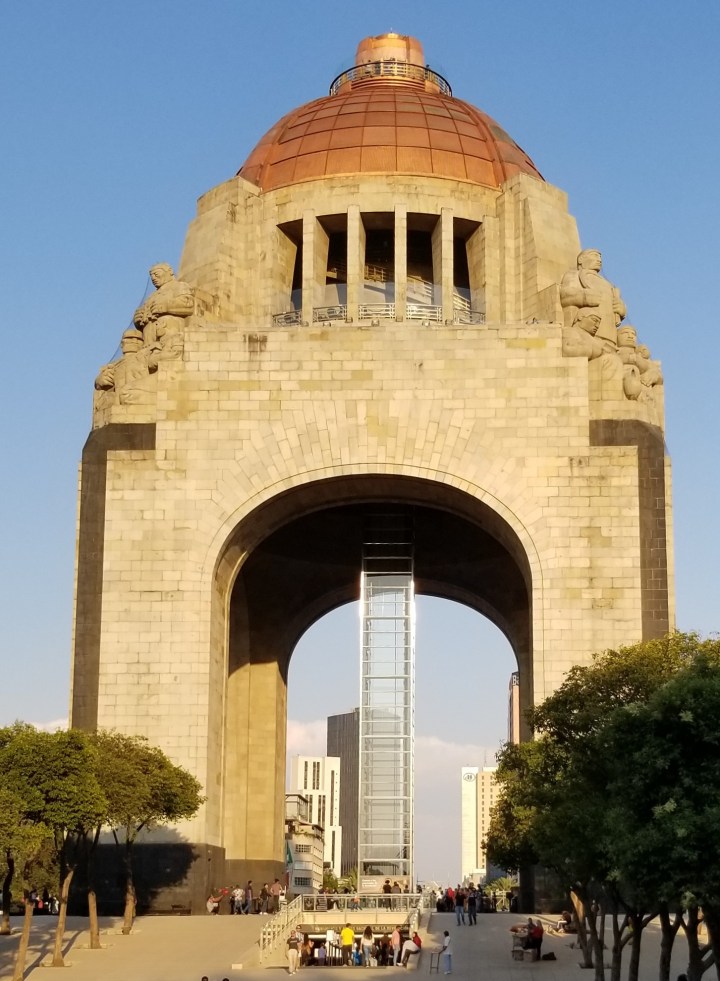
Monumento a la Revolución – Monument to the Revolution (my photo, Mexico City, 2019)
History Tidbit: November 20, 1910 marked the onset of the Mexican Revolution War, led by Francisco I. Madero. Different groups around the country had grown disgruntled with the dictatorship-like, thirty-year presidency of once army hero, general Porfirio Díaz Mori. I have mentioned Díaz as one of the brigadiers of the Mexican army who were, without doubt, instrumental in the Cinco de Mayo victory of the Battle of Puebla (May 5, 1862), against the invading French army. In 1871, he became, once again, chief defender of the Mexican democracy, rebelling against the re-election of president Benito Juárez. Díaz’s own first term as president began in 1877, then completely twirling his convictions to extend his presidency for another six terms; this period, named after him and known as “El Porfiriato” was characterized by sharp contrasts between the country’s economic progress, riches for the upper class, and extreme poverty and exploitation for the general population.
Although the deposition of Díaz only took a few months, and Madero had managed a pause in the battlefield and the establishment of a new government by mid 1911, the social and political turmoil – created by the revolt and three decades of oppression – were far from over. Madero was murdered in 1913, and a contra-revolutionary government led by Victoriano Huerta took over. Guerrilla and political leaders such as Pancho Villa, Emiliano Zapata, Alvaro Obregón and Venustiano Carranza, had very different goals and views, but were all against Huerta’s tyranny. Huerta was removed from power in July 1914, and eventually Carranza became president; his government drafted a new constitution, approved on February 5, 1917. Many historians consider this as the official end of the conflict, or shortly after when Alvaro Obregón was elected president, in 1920. However, regional revolts and their associated bloodshed subsided only gradually; all four of the aforementioned leaders were murdered: Zapata in 1919, Carranza a year later, Villa in 1923 (three years after he had retired to his farm), and Obregón in 1928 after seeking re-election.
One of the most iconic structures in Mexico City is El Monumento a la Revolución – the Monument to the Mexican Revolution (photo at the top of this post.) The monument is the result of an unfinished architectural project in the city’s downtown, to become Mexico’s Capitol. The “Federal Legislative Palace” was designed by a French architect in Neoclassical style, with a cupola and surrounded by columns. The project was ironically commissioned by no other than Porfirio Diaz, who laid the first stone in 1910. After Diaz’s ousting just a few months later, the newly elected president, Francisco I. Madero, supported the work until his assassination in 1913.
The domed shell of the cupola remained abandoned, until the mid 1930s, when the then president Lázaro Cárdenas, a general during the war, approved the proposal of Mexican architect Carlos Obregón Santacilia to convert it into a monument to commemorate the heroes of the Mexican Revolution. The structure became an eclectic Art Deco arch with four columns, and sculptor Oliverio Martínez de Hoyos created stone sculptures for the monument, which sit at each of the four corners at the base of the dome, representing Independence, the Reform Laws, Agrarian Law, and Labour Law. The whole work was completed in 1938.
The remains of some of the heroes of the Mexican Revolution War were relocated to the basement of the monument, becoming a museum and a mausoleum for Pancho Villa, Francisco I. Madero, Plutarco Elías Calles, Venustiano Carranza, and ultimately, Lázaro Cárdenas himself. Alvaro Obregón is not buried in the monument, with his remains still in Huatabampo, in his natal state of Sonora; and Emiliano Zapata rests in Cuautla, Morelos, mostly since his family has resisted the relocation of his remains.
Monument to the Revolution – current address: Circuito De La República 33, 06030 Cuauhtémoc, CDMX, Mexico. Museum Hours: Monday through Thursday: 12 p.m. – 8 p.m., Fridays & Saturdays: 12 p.m. – 10 p.m., Sundays: 10 a.m. – 8 p.m.




 My Slice of Mexico
A sober history lesson.
LikeLiked by 1 person
Yes, as I see it, re-election is a flaw of democracy
LikeLiked by 1 person
Laws are only as effective as officials and the electorate allow.
LikeLiked by 1 person
Thank you for recounting these key events of Mexican independence and the background behind the monument.
LikeLiked by 1 person