
Mexico has several mountain ranges; the Trans-Mexican volcanic Belt (Eje Volcánico Transversal) runs West to East through Central Mexico. This belt comprises the tallest mountains in the country, starting with Pico de Orizaba at 18,491 feet (5, 636 m), located on the border of the states of Puebla and Veracruz; second is the Popocatepetl (17,749 feet – 5, 410 m), followed by the Iztaccihuatl (17,159 feet – 5, 230 m), these two volcanoes next to each other, in the states of Puebla, Morelos and Estado de México (Edomex), connected by the Paso de Cortés. The Volcano Route (La ruta de los volcanes), is a pleasant drive that goes along Mexican Federal Highway 115, offering views of the two volcanoes to the East; from Mexico City, it goes South to the state of Mexico (Edomex) through the towns of Tlalmanalco, Chalco, Amecameca, and Nepantla, then into the state of Morelos to Cuautla (click here to see the route on Google maps.)
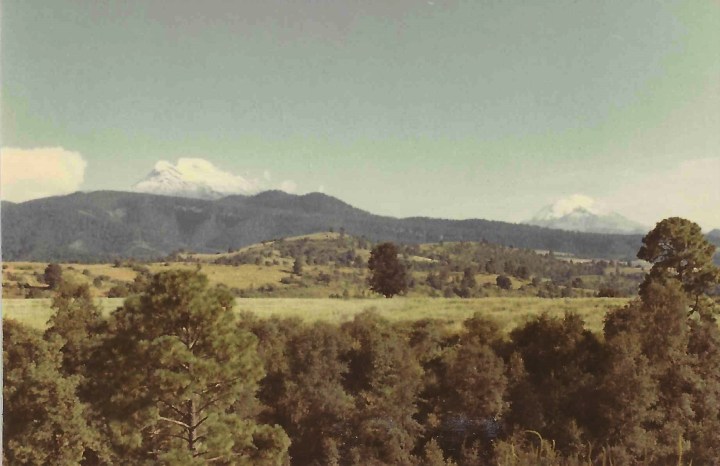
One of my dad’s favourite daytrips was to follow part of this route, making a couple of stops on the side of the road to take pictures of the volcanoes, on our way to Amecameca. The photos in this post are from one of our trips (circa 1969). The photo at the top of this post was probably taken outside Chalco, showing the Iztaccihuatl on the left, and the Popocatepetl appearing in the background, to the right.
Farther south, the highway winds around the skirt of the mountains, offering closer views. In the photo below, the Iztaccihuatl, Nahuatl name that means “white woman”, for the resemblance of its snowy peaks to a sleeping female figure:
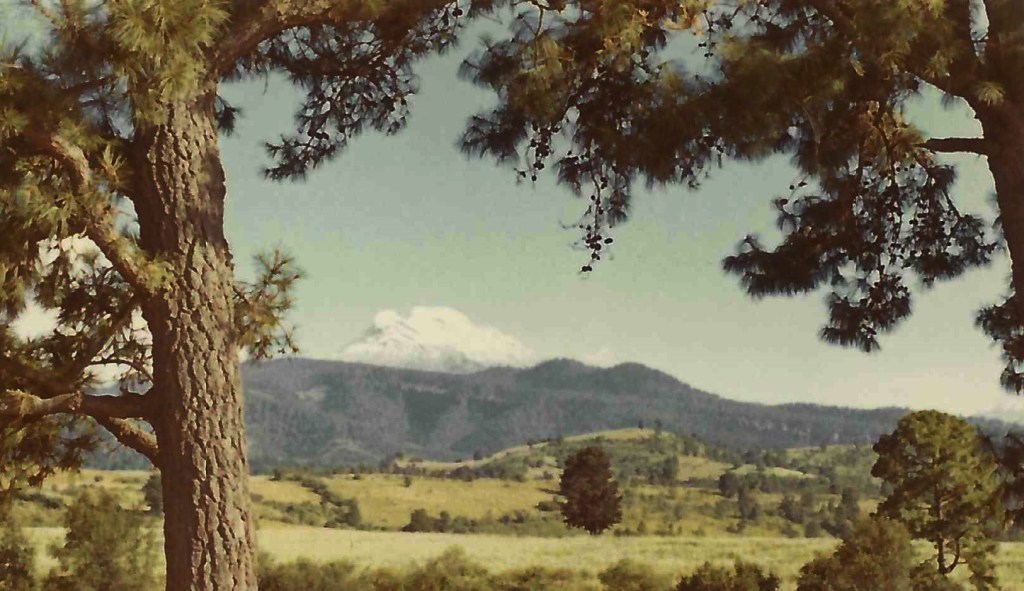
Outside Amecameca, a nice view of the Popocatepetl:

Looking for handcrafts, and buying cheese and ice cream in Chalco were regular activities, and I still remember the special time when my dad let my brother and I ride horses near Amecameca; it was just a gentle stroll guided by the horse keeper, but for a young girl such as myself, it was a big adventure:

To all fathers, grandfathers and loving fatherly figures in our lives:
Happy Father’s Day! ¡Feliz Día del Padre!

The Iztaccihuatl is also known as “The Sleeping Woman ” – La mujer dormida, very appropriately since it is an inactive volcano, unlike the Popocatepetl, which literally translates from Nahuatl as “smoking mountain”. Throughout the centuries, the Popocatepetl has presented periods of high activity and others of relative calm and dormancy. After brief explosions of steam and ash in 1947, it remained practically dormant until 1994; during this time, the volcano became a popular destination for hiking and climbing, regardless of the level of expertise of the visitors, since there were some routes that required a guide, but no special equipment other than hiking boots.
When I was working at the National University in Mexico City in the 1980s, a group of friends organized an excursion to hike to the crater, and I joined, very reluctantly since I do not like heights, but realizing that it was a one in a lifetime opportunity. Back then, it was possible to drive to the nearby post of Tlamacas, already at an altitude of 13, 000 ft (3,962 m). Staying there overnight was the way to go, to get used to the “thin” air; we started the ascend early the next morning, and I was holding up fine until we passed the 5,000 m mark (about 16, 404 ft), and I started feeling lightheaded; we stopped for a break, I turned around to sit down, and suddenly realized that the cloud line was below my eye level! I simply collapsed into the sand, wishing I could hug the mountain. I continued for a little longer, and I was told I was just 50 m (150 ft) adrift of the summit, but my legs were heavy, and I could not go any further; I asked my friends to let me be, and pick me up on their way down. They were very gracious and told me that the crater “was not that cool, kind of smelly” (LOL). The descend was surprisingly easy, as it was fast to slide down where there was sandy terrain, and in the end, I was happy I had done it, and survived the ordeal.
In 1994, the Popocatepetl “woke up” again, spewing gas and ashes, and prompting evacuations. Since then, further activity caused the authorities to close access to the summit, and the once thriving base of Tlamacas, is now abandoned. I guess it was indeed a unique opportunity to climb the Popocatepetl; even if I did not make it to the crater, it was another big adventure for me in los volcanes.
Below is a report of recent activity and state of alert (May 2023):






Wonderful memories! Thank you for honoring your father.
LikeLiked by 1 person
Beautiful photos!
LikeLike
Thank you, MsJadeLi!
LikeLiked by 1 person
You’re welcome, Irene.
LikeLiked by 1 person
Qué bonitos recuerdos hmp!
LikeLiked by 1 person