
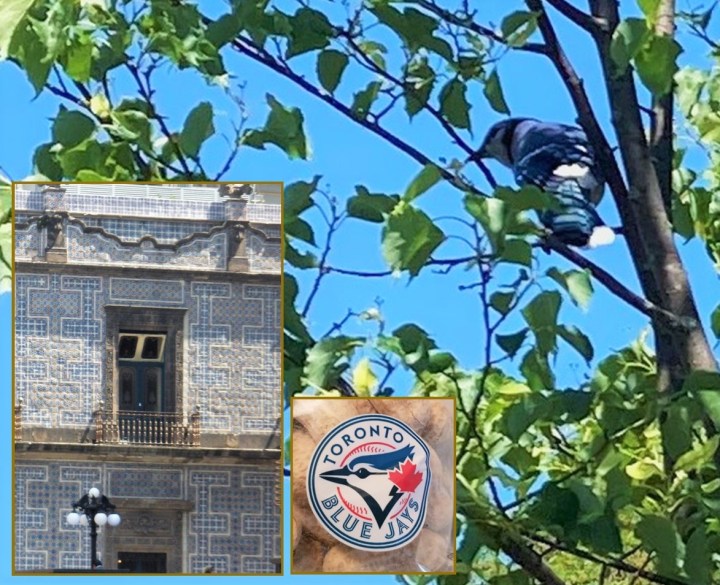
Languages are a fascinating instrument to follow history and folklore through their words. A perfect example is the Spanish word azulejo. According to the Royal Academy of the Spanish Language (RAE), azulejo has two principal uses:
First, naming anything related to azul, which is the Spanish word for the colour blue. An example is the cornflower (Centaurea cyanus), a plant that grows wild in corn (grain) fields, and has blue flowers, for which is called trigo azulejo (bluish wheat); also a number of animals with bluish shades are called azulejo, from bridled horses, such as the blue roan, to wild birds, for example the European roller (Coracias garrulus) , and the North American Blue Jay (Cyanocitta cristata), pictured below:

A poised blue jay stands on the fence, looking over a stranded fledgling (red oval):

(I am happy to report that the youngster made it out of its predicament, and the backyard, unscathed.)
The second use of azulejo is to name a type of glazed tile; although a lot of ancient and traditional azulejos are indeed blue (as seen below), the etymology of this second definition surprisingly (at least to me) has nothing to do with the colour of the tile.

These glazed tiles were introduced to the Iberian peninsula by the Moors; they are called alzulij in Arabic, from al – an article, and zellij- zellige – a type of Moroccan tile. All around Spain and Portugal, azulejos adorn façades, walls, floors and other architectural structures, such as ledges and fountains. There are many examples of azulejo in blue (photo below, left), but historically speaking, there were handcrafted more frequently in red, yellow and shades of green (photos below, centre and right):
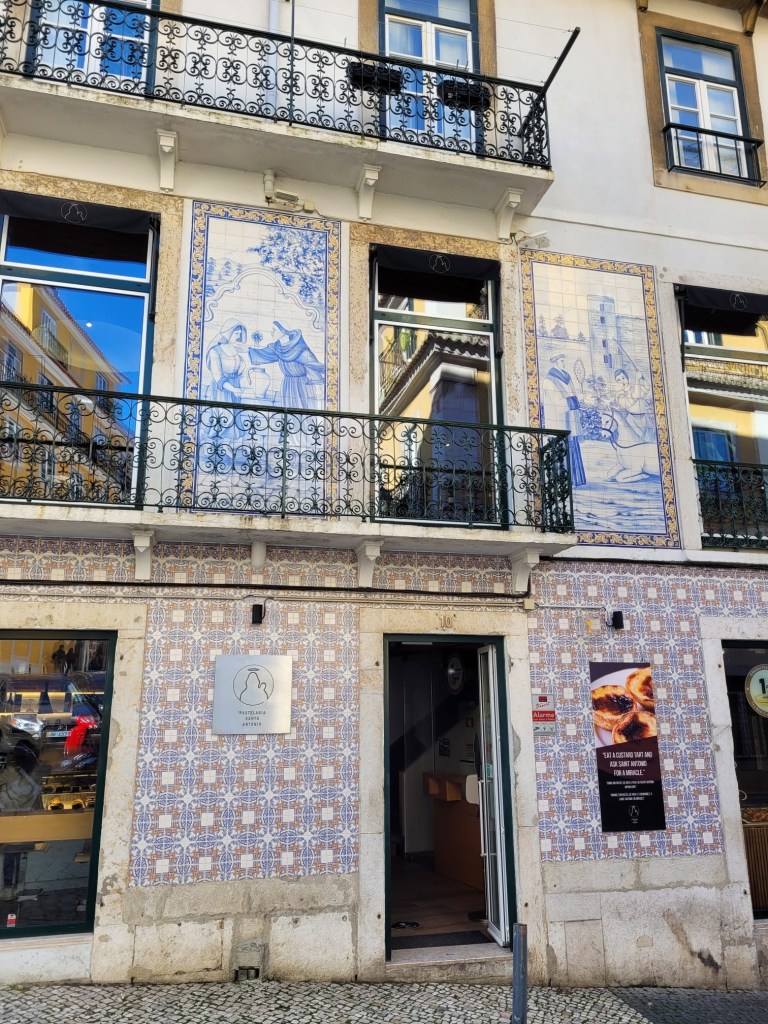


Below, Spanish examples of azulejo in Seville (left) and Granada (right):


Many sports teams are named after occupations or trades in their home town, such as the American football team, the Pittsburgh Steelers, and the Mexican soccer team Cementeros del Cruz Azul, based in Mexico City and owned by Cruz Azul, a cement company. When I was a kid, on top of thinking that the origin of azulejo referred to the colour blue, I only knew the word azulejo in relation to tiles, so when I first heard the name “Azulejos de Toronto”, on the radio, while my dad was listening to Major League baseball coverages in Spanish, I always imagined that the city of Toronto had a big tile factory (LOL). When I first arrived to Canada and visited Toronto, I was surprised to see the mascot was a bird! (logo, photo below). Of course, then it became clear that “azulejo” was also the name in Spanish of the blue jay, and indeed called azulejo after the colour of its plumage.

I was lucky to attend one of the Blue Jays‘ last games at their original home, The Exhibition Stadium (1976-1988), and have also been at their new venue with a retractable roof, for concerts and a ball game (called originally Sky Dome, now Rogers Centre). The Blue Jays have been the East Division champions six times, and won the World Series back to back, in 1992, and 1993. They sank to the bottom after that, but in 2023 they are playing a winning season, third place in their division so far.
Below, a couple of their official snacks:


FUN FACT: Hotdogs have always been a classic ball park treat. During every Blue Jays home game that takes place on a Tuesday, The Rogers Centre runs a promotion called Loonie Dogs Night; Schneider™ hotdogs are sold for one Canadian dollar (nicknamed loonie), with a limit of four hotdogs per transaction. On July 18, 2023, even though the Blue Jays lost against the San Diego Padres (1-9), attendants indulged in loonie dogs with impunity, purchasing a record 75,173 that night.




 My Slice of Mexico
I’ve lived in Mexico for 22 years and this is the first time I’ve heard why azulejos are called azulejos. I always imagined that the first tiles made were blue and thus the title handed down through the ages. Thanks for the explanation.
LikeLiked by 1 person
I thought the same for the longest time, Judy… and thought the Toronto Blue Jays were tile crafters, too, lol.
LikeLike
Enjoyed the tiles and explanation of their origin. And, that’s a lot of hotdogs!!
LikeLiked by 1 person
I just checked, the capacity of the Rogers Centre is 49,286, so it’s close to 1.5 hotdogs per person, assuming a full house…wow, it is a lot of hotdogs!
LikeLiked by 1 person
You’re like me – had to see just what the per person consumption must have been! 😊
LikeLiked by 1 person
😁👍
LikeLiked by 1 person