

Click here to go to printable recipe: Dogos – Sonora Style Hotdogs
History Tidbit: Hotdogs and Dogos
The term sausage comes from the Latin word salsus – salted, describing the original preservation method of small scraps of meat and organs; sausages in animal casings are mentioned as early as the 8th or 9th century BC in Homer’s Odyssey, described as a blood and fat sausage. Sausage links of different thicknesses and lengths, as well as types of filling, were developed in parallel all around the world. In particular, the creation of thin sausages nicknamed dachshund – “little dog”, is generally credited to Germany (Frankfurter Würstchen) from around 1487, made with pork, and later to Austria (wienner, from Vienna), made with a mix of beef and pork meat.
The “franks” and “wieners” arrived to the United States sometime in the mid 1800s, sold on the streets of New York City by European immigrants. These sausages had always been served with bread in Europe, but it is not clear at what point they were served on a sliced soft roll in the US; baker Charles Feltman, a German immigrant, is generally recognized as the first to open a stand in Coney Island, NY, in 1871, reportedly selling 3,684 dachshund sausages in milk rolls that year. At some point, the name dachshund (little dog) was dead and became a “hot dog” or hotdog, and by 1893 had appeared in expositions around the US and, maybe for the first time at a Major League Baseball park, during the games of the St. Louis Browns, owned at the time by German immigrant and bar owner Chris von der Ahe.
Sausages arrived in Mexico during Spanish colonial times in the form of, for example, chorizo, and morcilla (blood sausage), and Vienna sausages were introduced during the brief reign of Maximilian of Habsburg (1864-1867). The introduction of hotdogs in Mexico, specifically, is accredited to the arrival of baseball to the country, which occurred at the end of the 1800s in different regions, and for different reasons. In Guaymas, Sonora, by American sailors; in Nuevo Laredo, Tamaulipas, and Monterrey, Nuevo Leon, by American workers during railroad construction; and in the South, in the Yucatan peninsula, for its proximity to Cuba, a protectorate of the USA from 1898 until 1902. By the mid 1900s, hotdogs could be found everywhere in Mexico, and later, hot dog buns were mass produced, and since have also been marketed as “medias noches” – “midnights”, after a Spanish snack that was enjoyed late at night, consisting of a small roll, sliced lengthwise and filled with cold cuts, cheese, etc.
Hotdogs made their way to Northern Mexico across the American border, as well. In the state of Sonora, both baseball and hotdogs are big traditions. In particular, after WWII ended in 1945, Cipriano Lucero, a Mexican who had lived in California, and served as a cook for the American army, went back to his natal Hermosillo, Sonora; he married Luz Celia Ajá, and together decided to open a restaurant serving American style food. Café Kiki opened in 1947, serving amongst other American and Tex-Mex dishes, the chili dog, consisting of a classic hotdog with mustard and ketchup, then topped with beans and peppers. Hotdog buns were not available back then in Mexico; Cipriano and Luz Celia solved their dilemma by asking a local baker to develop a soft, long bun, which became the norm for Sonora style hotdogs.
The modern Sonora style hotdog, called dogo sonorense, took off in the 1980s, with some additions and extra toppings. Nowadays, wrapping the sausage with bacon, and topping with caramelized onions, tomatoes, and mayonnaise have become the classic way for dogos, as it is to include a side of fries:
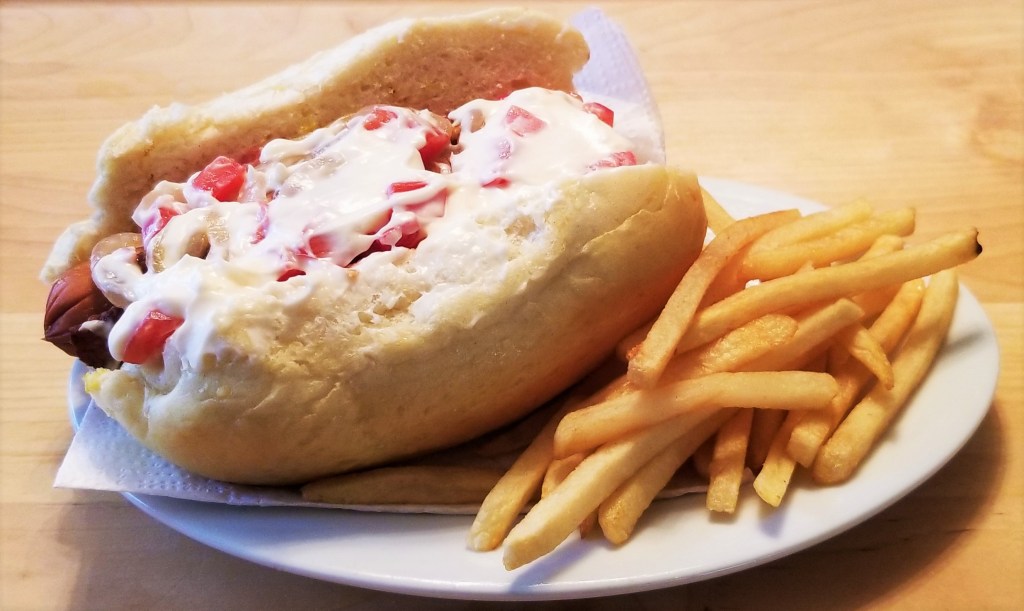
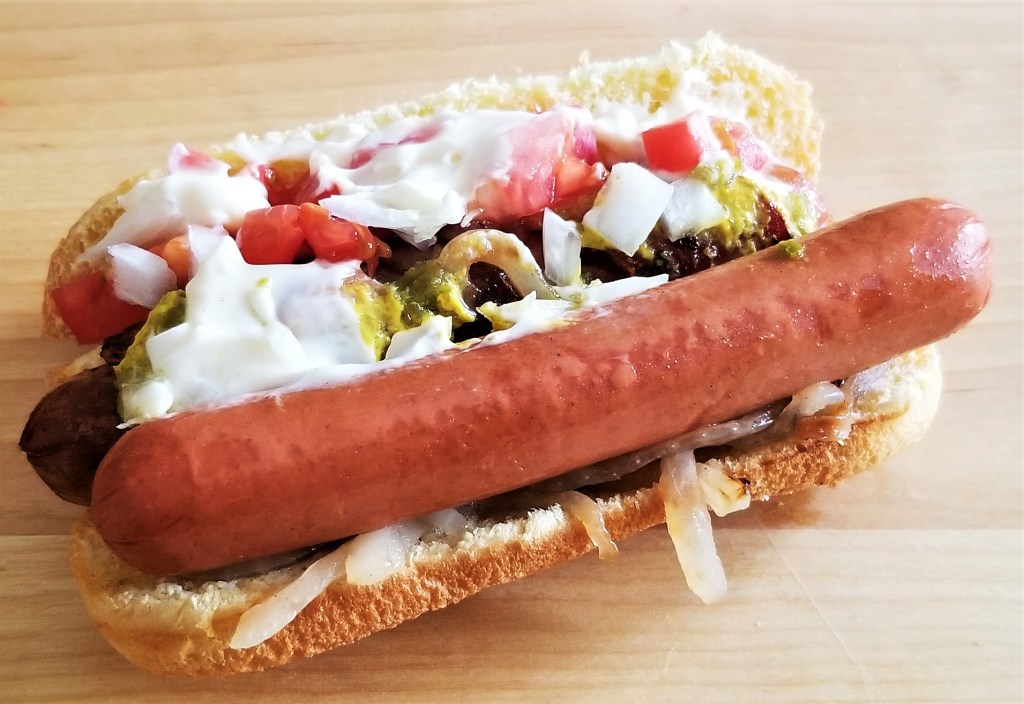
Mustard and pickled jalapeño sauce are staples, too, as shown at the top of this post.
Over the last decades, through the monkeyshines of street vendors in different municipalities in Sonora, the dogo has become almost a piece of art, with each place or stand offering their own unique toppings and techniques.
Sonora Style Hotdogs – Dogos sonorenses
Printable recipe: Dogos – Sonora Style Hotdogs
Classic
Ingredients (for six portions)
6 hotdog sausages, such as Franks, ballpark all-beef, etc.
6 large soft buns, such as dogo bun (click here for recipe), brioche, submarine, etc.
6 slices good quality bacon
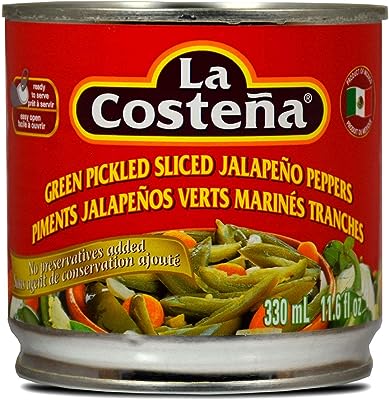
1 cup pickled jalapeño peppers, with some liquid (homemade, or from can)
1 onion; peeled and sliced thinly
2 tbsp oil
Salt, to taste
1 tomato; washed, and chopped
Mayonnaise
Yellow mustard
Side: Potato chips or fries
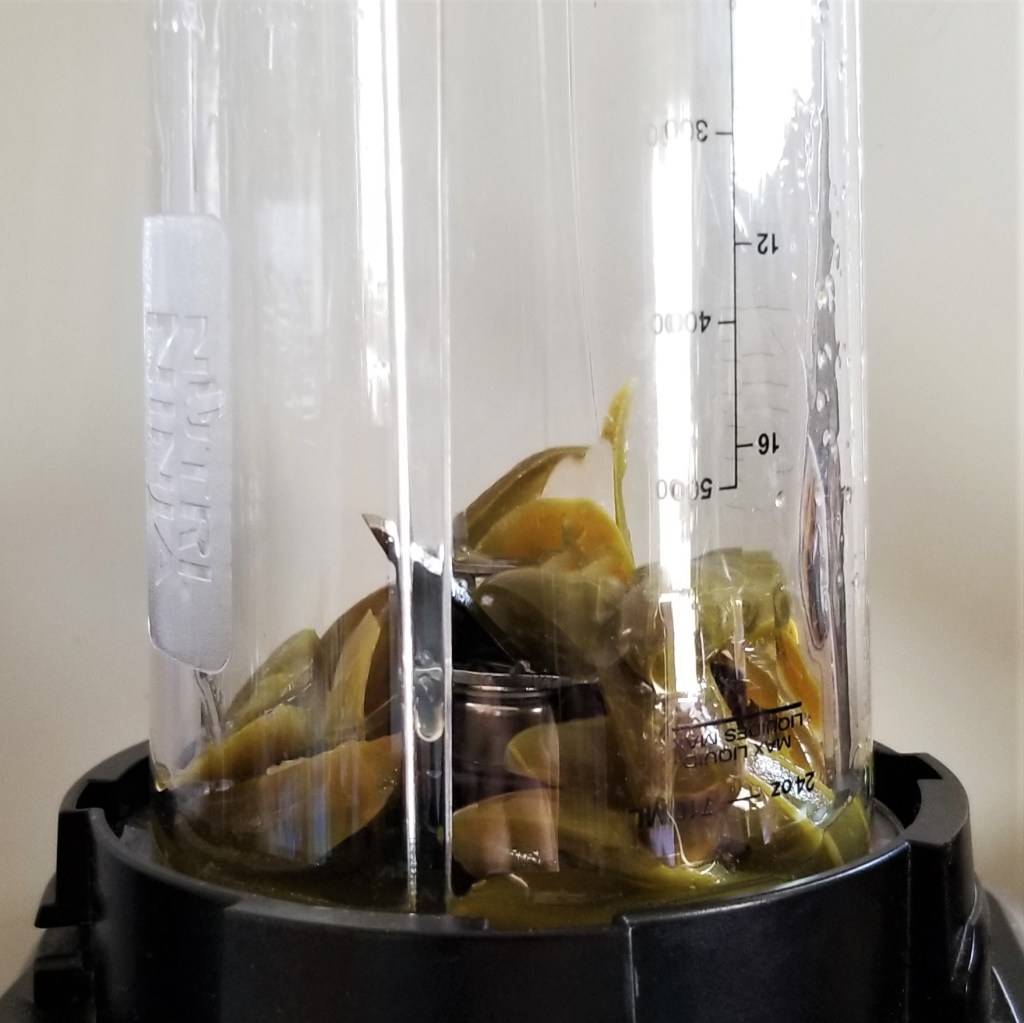
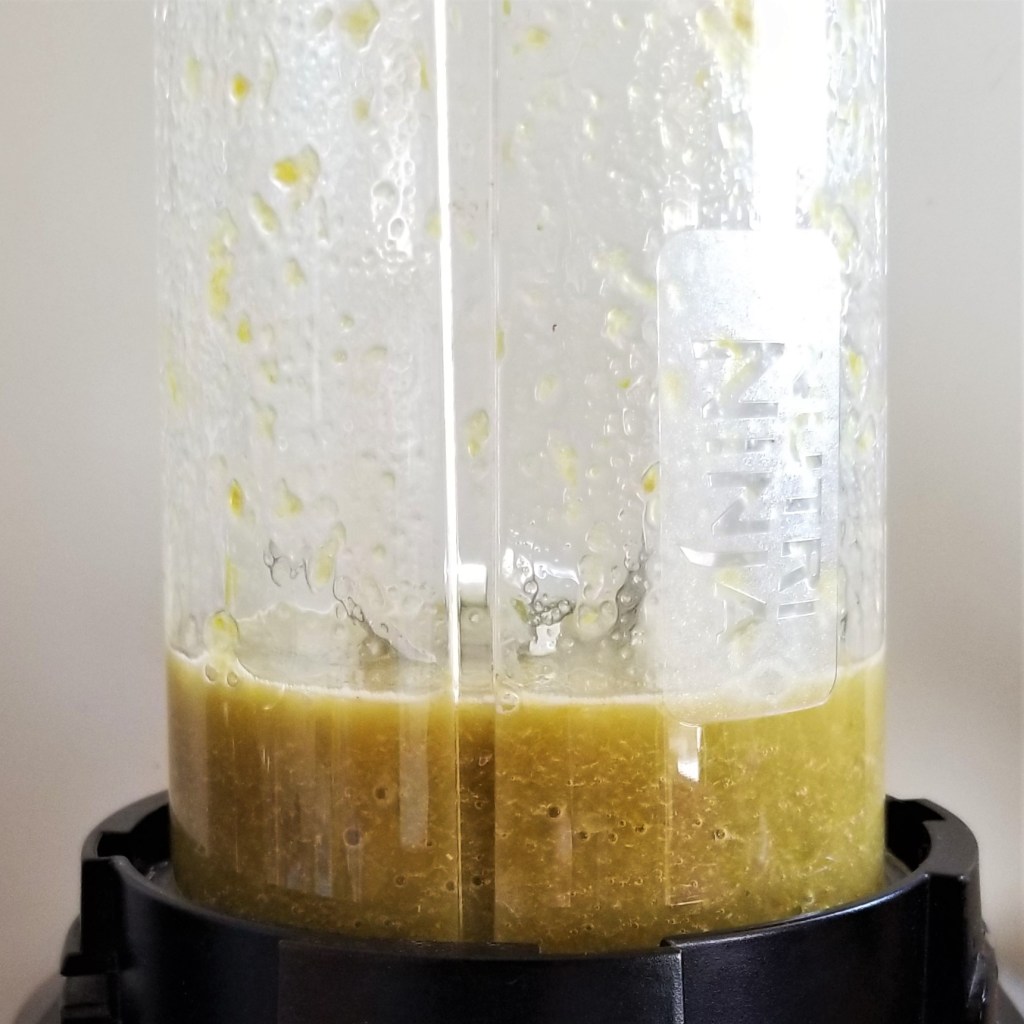
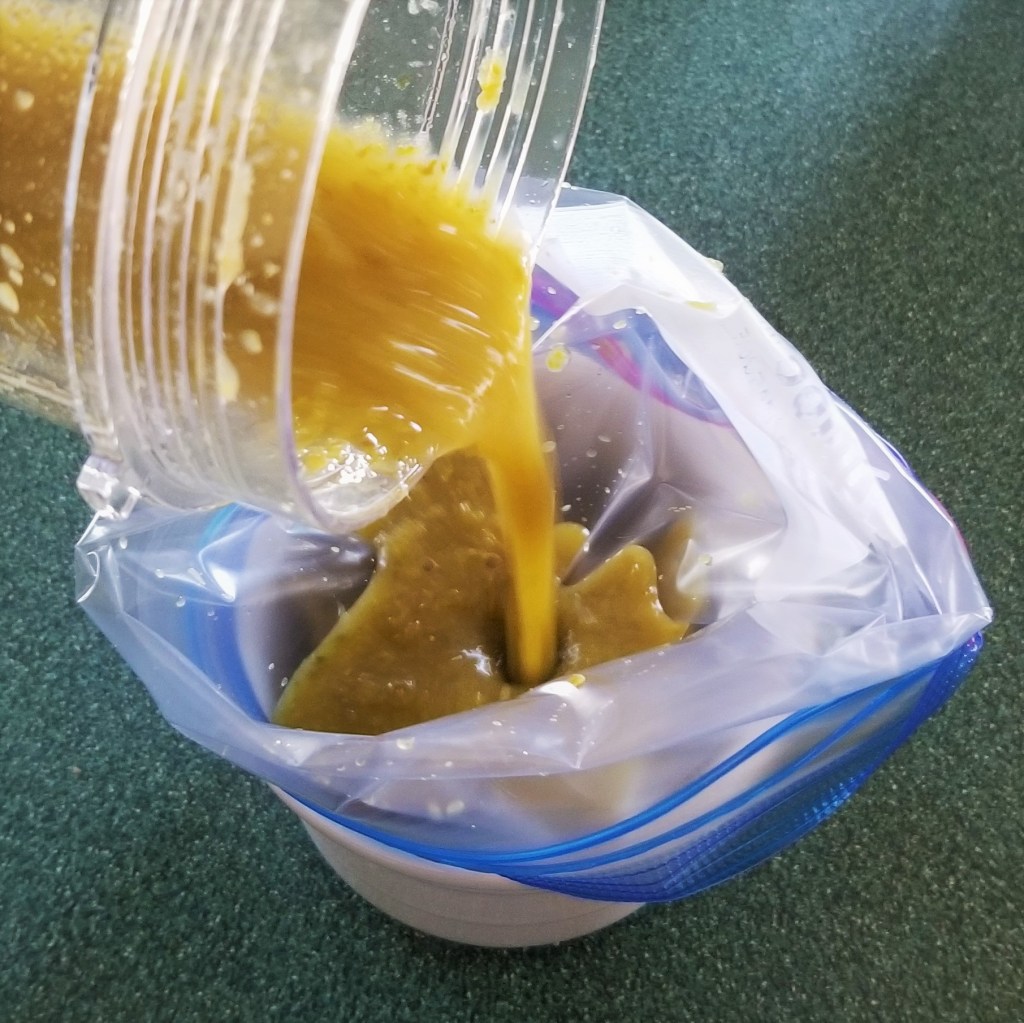
Prepare pickled jalapeño sauce – Remove stems and seeds from peppers, then place in a blender jar, along with some of their liquid (photo below, left). Process until smooth (photo below, centre). Transfer to a squirt bottle, or to a sealable plastic bag (photo below, right):
Reserve.
Prepare fried onions – warm up oil in a frying pan over medium heat, then add sliced onions (photo below, left). Cook, stirring occasionally, until the onions begin to turn brown and caramelize (photo below, right):
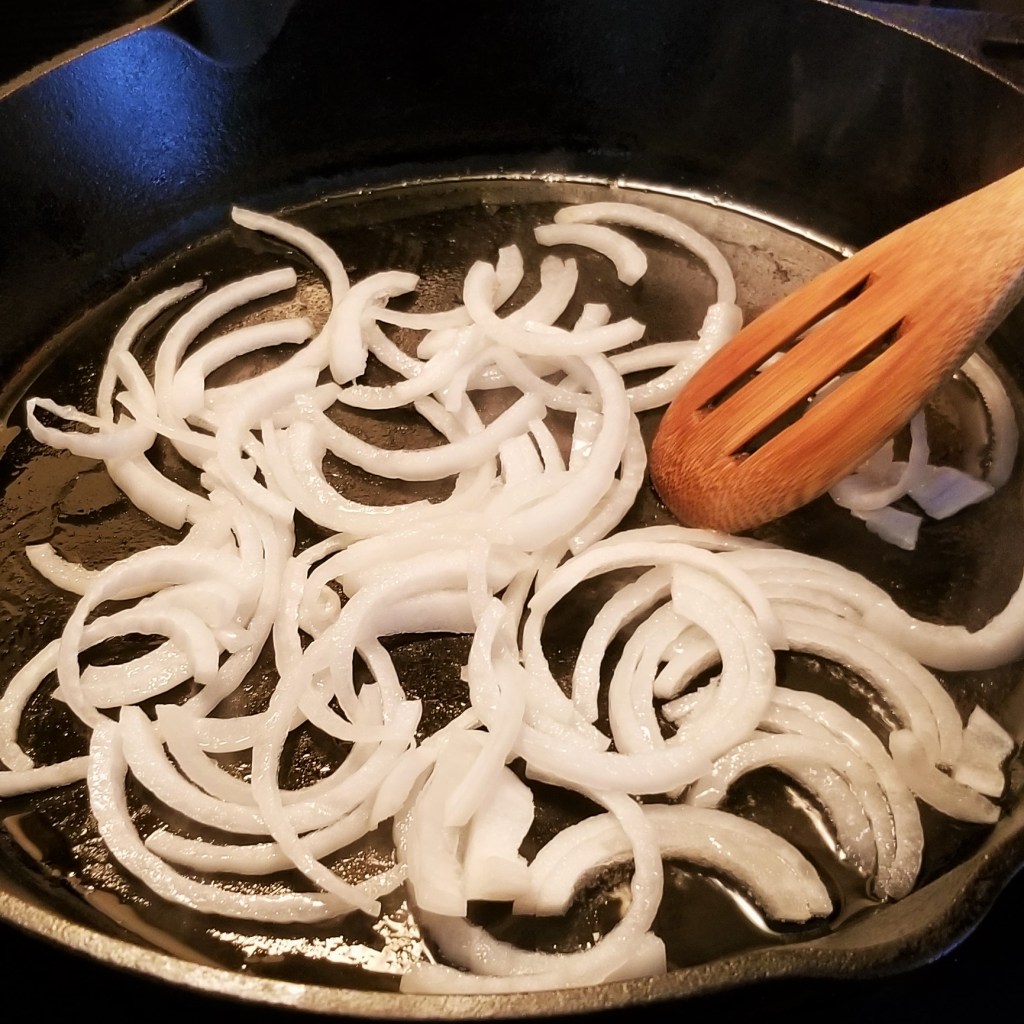
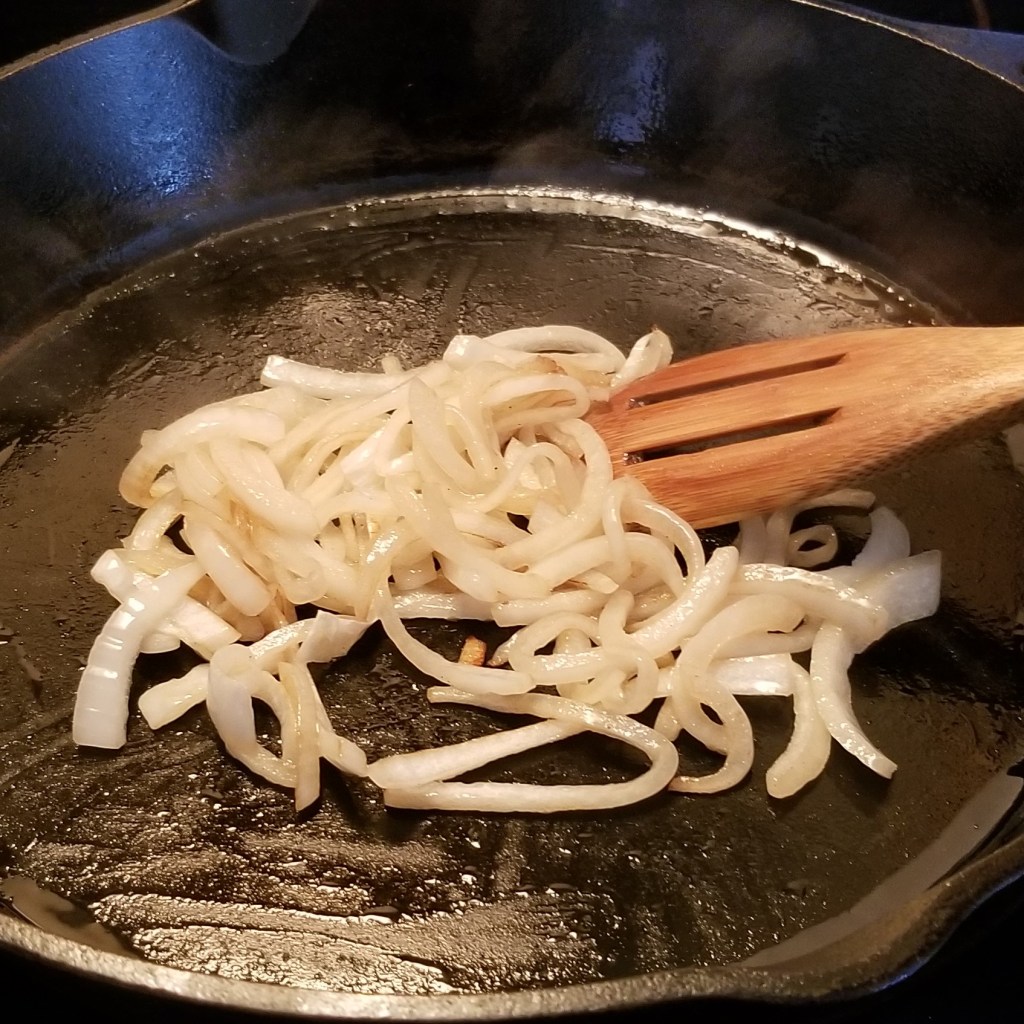
Season with salt, to taste. Transfer to a bowl and reserve.
Prepare sausages – Starting at the top of each sausage, place a slice of bacon in diagonal, and wrap around, until covered:
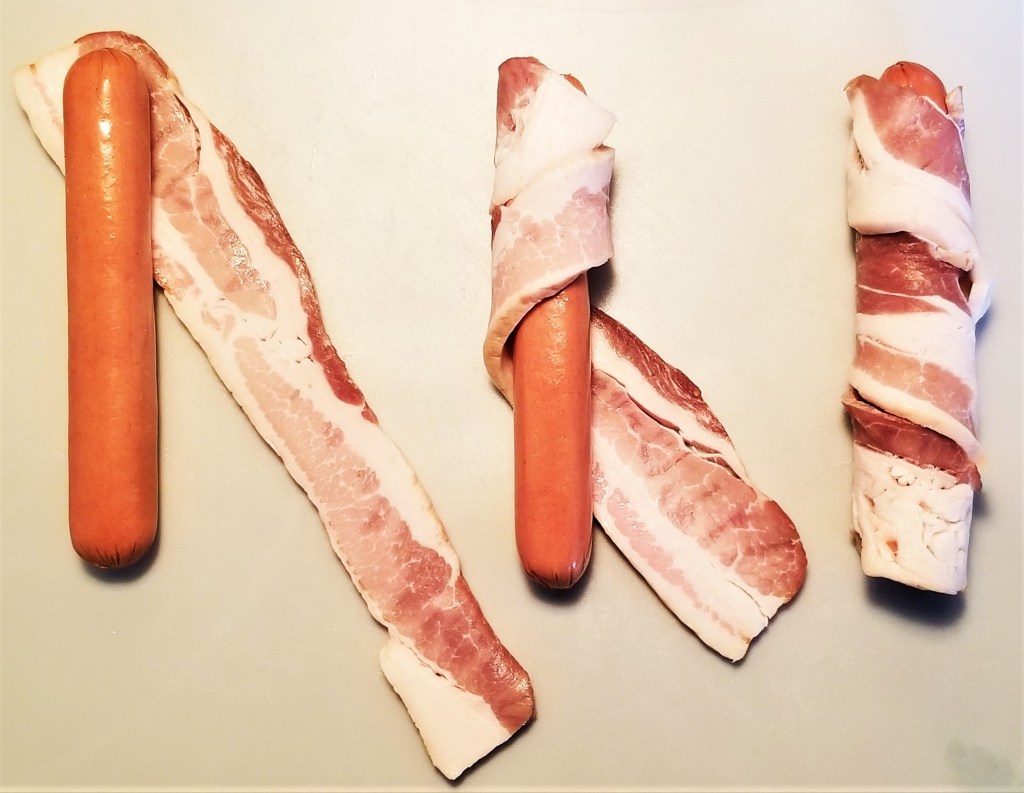
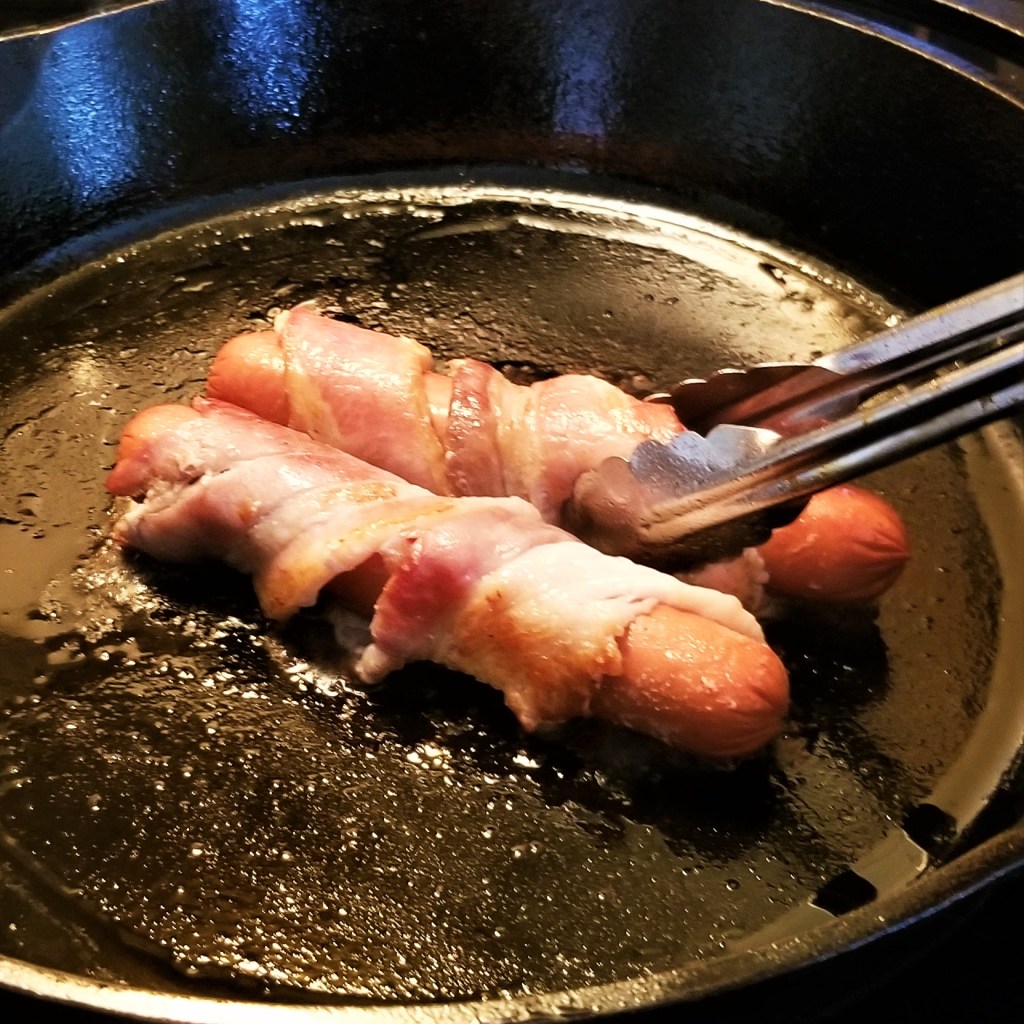
Fry sausages. with the bacon ends facing down, in a pan over medium heat (photo below, left). Turn to brown on all sides (photo below, right):
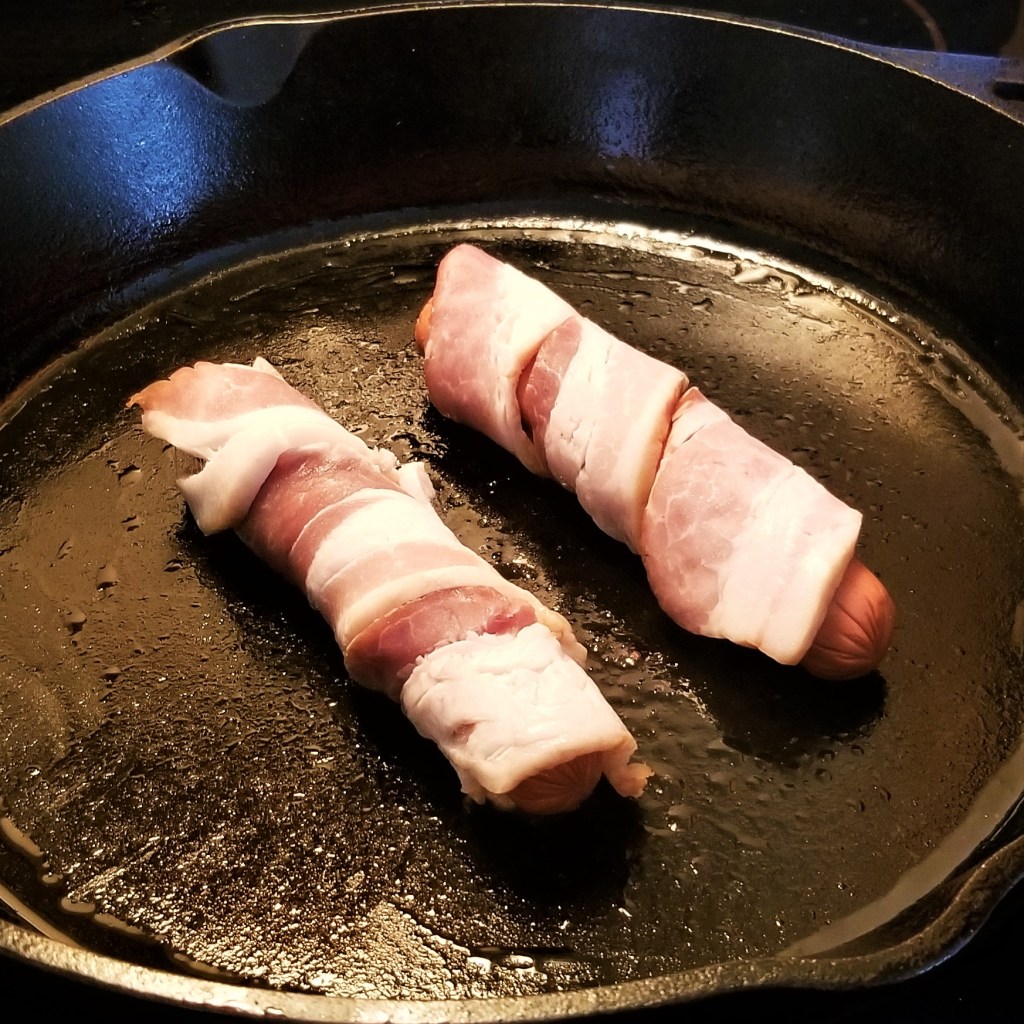
Keep warm.
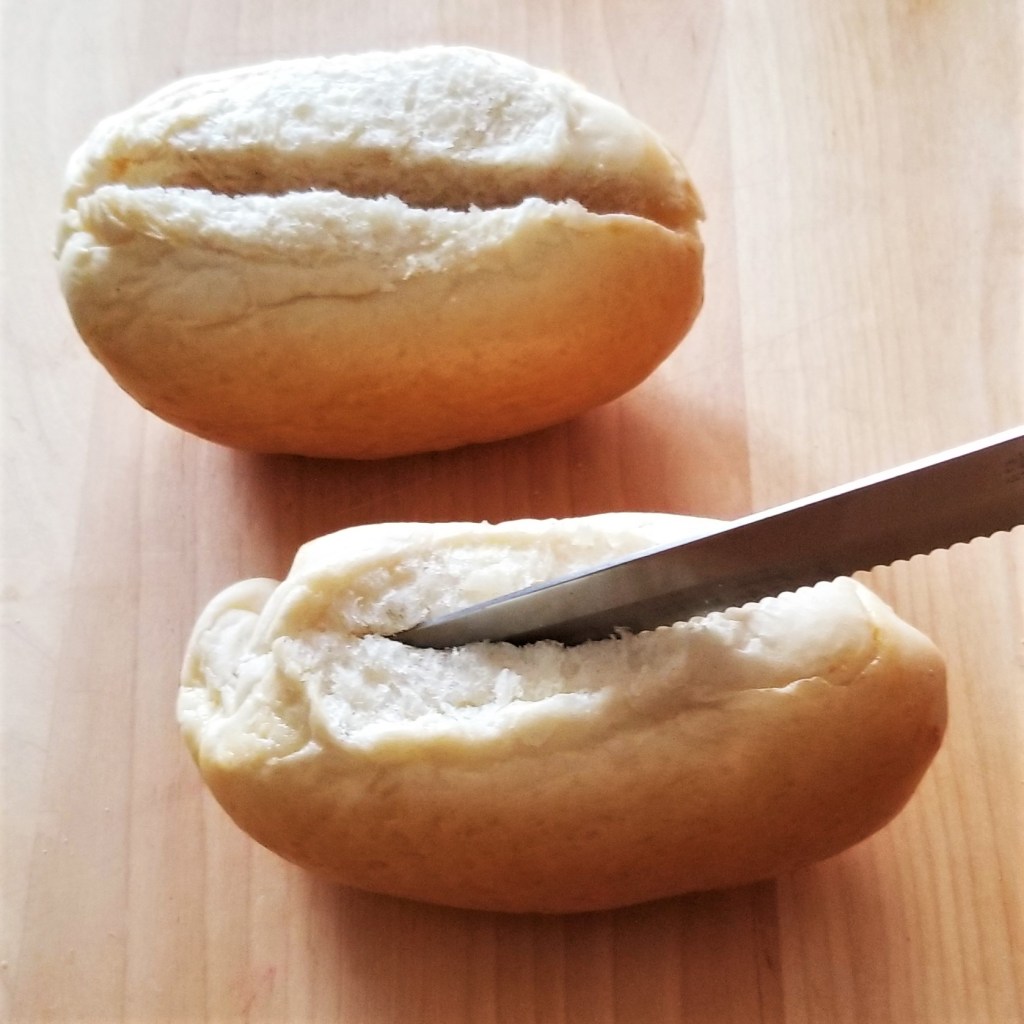
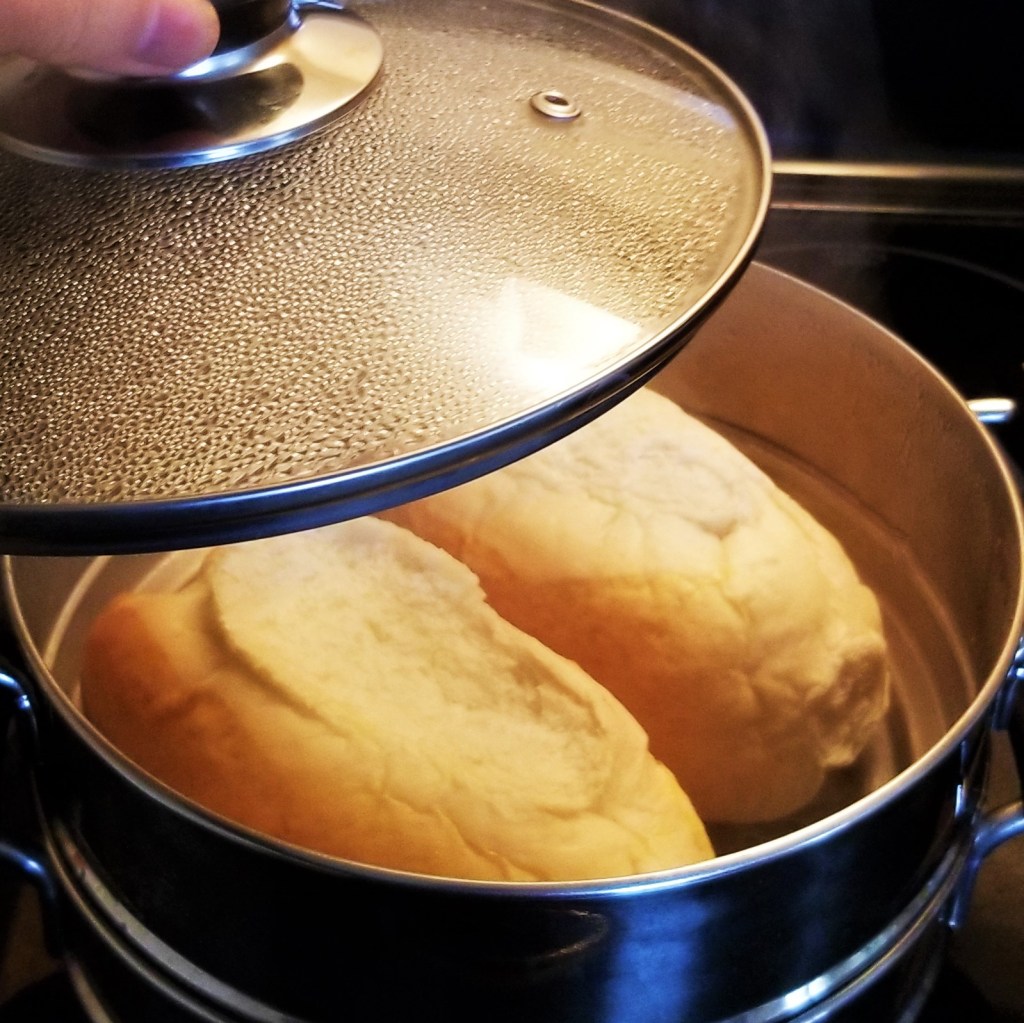
Steam buns – Open buns on one side, forming a pocket (photo below, left). Place in a steamer, or a colander set over a pot with boiling water, then cover, to warm up (photo below, right):
Assemble dogos – Set up reserved onions, chopped tomatoes, mayonnaise, mustard, and reserved jalapeño sauce (if in a plastic bag, make an opening with scissors, to use as a piping bag). Spread mayonnaise on one bun, and place one bacon-wrapped sausage in:
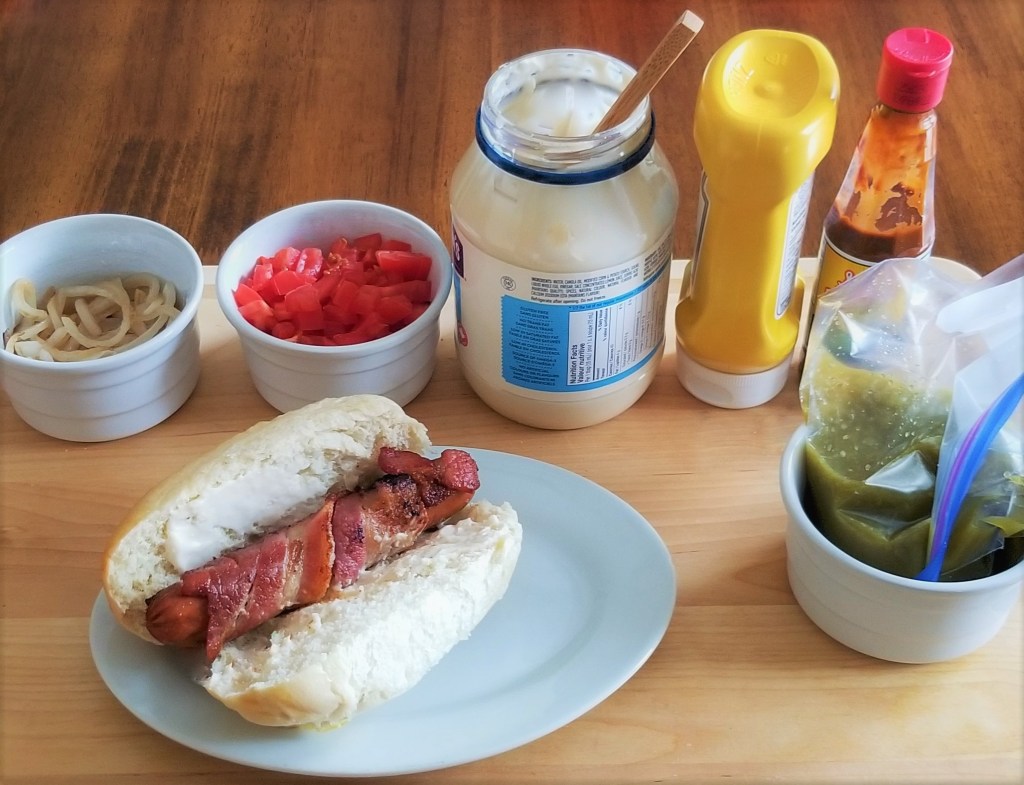
Top with onions, then tomatoes, and finish with more mayonnaise
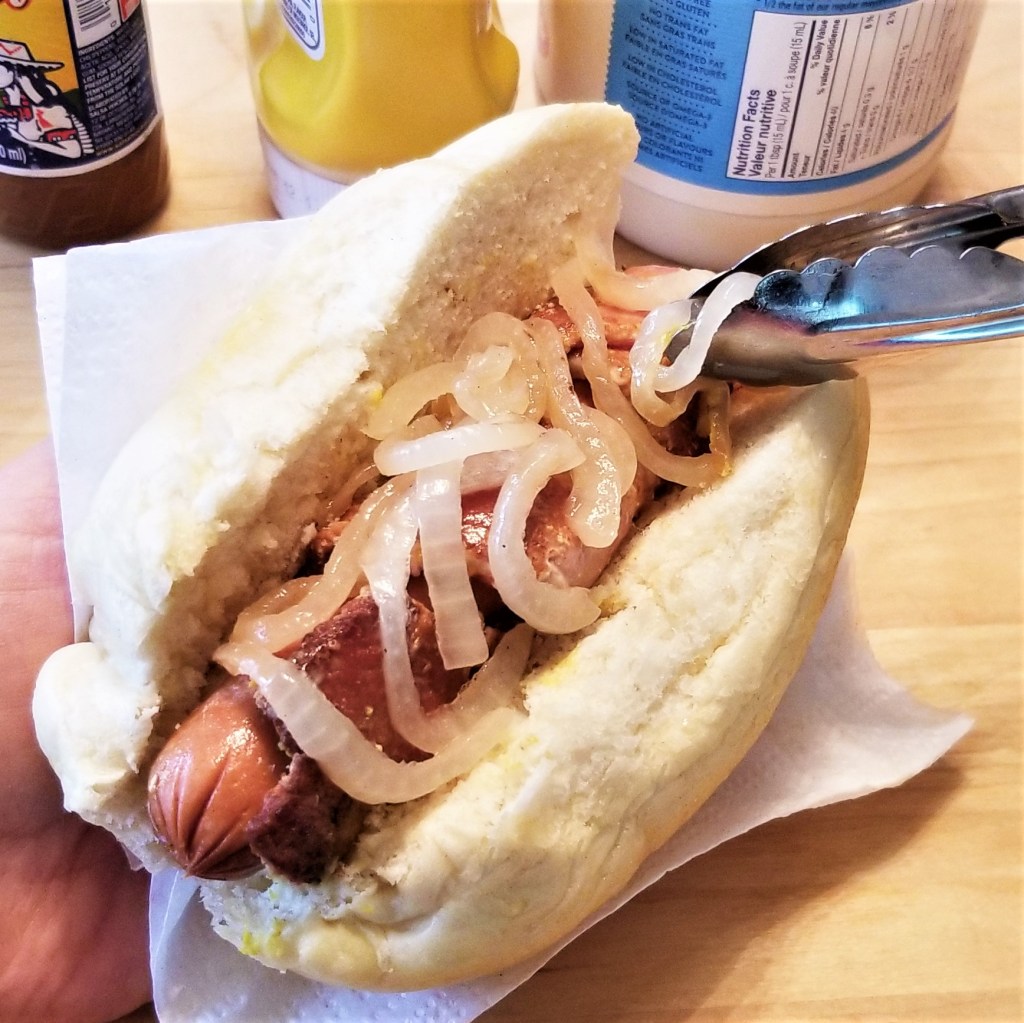
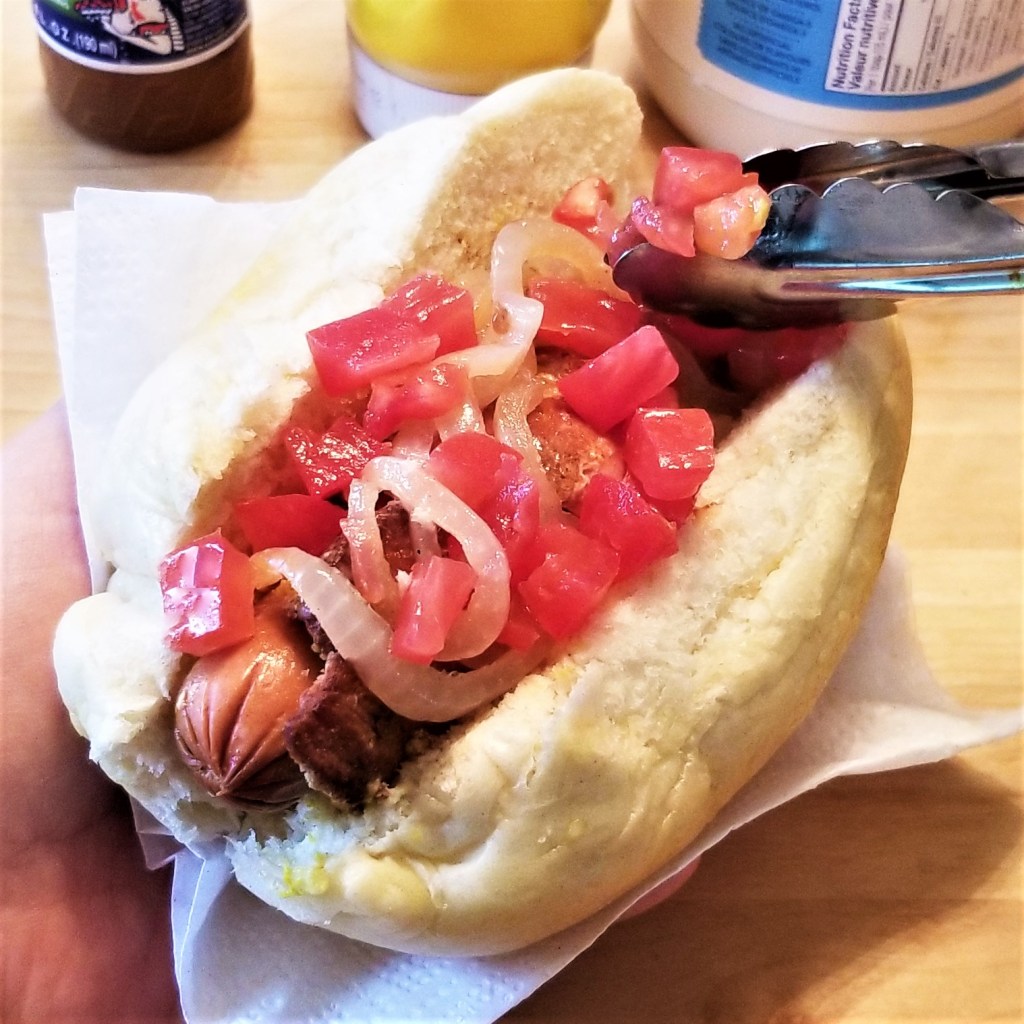
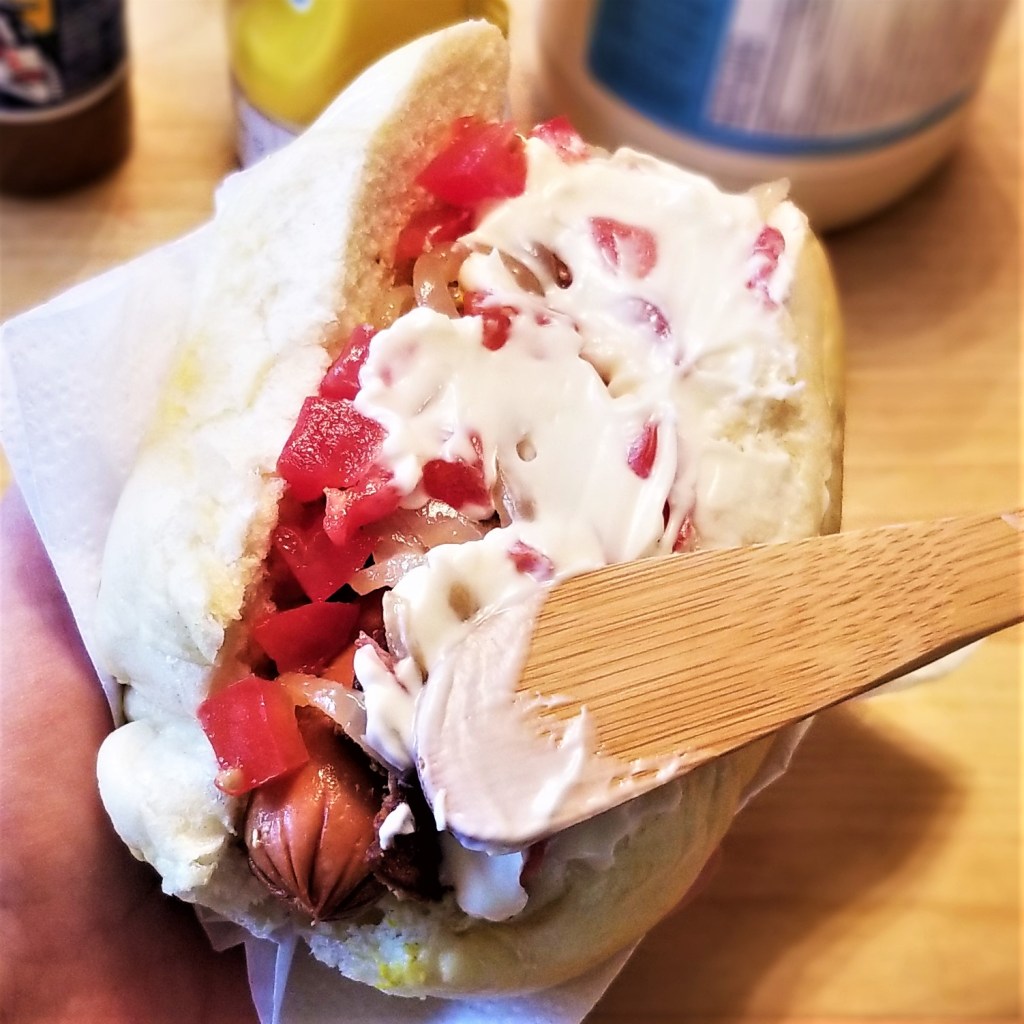
Serve with a side of fries.
Classic Dogo
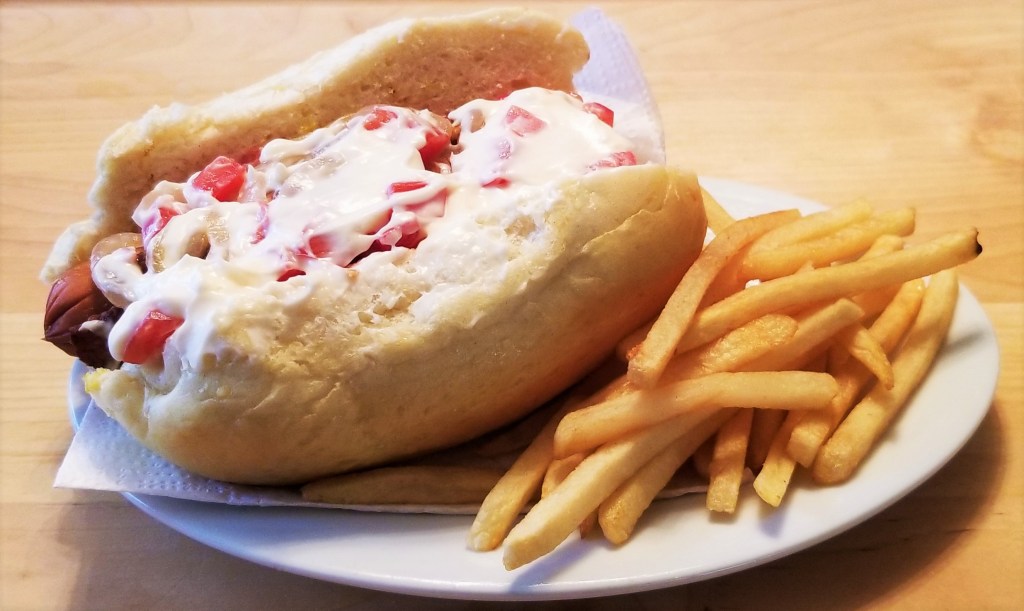
Topping with mustard and jalapeño sauce is popular:
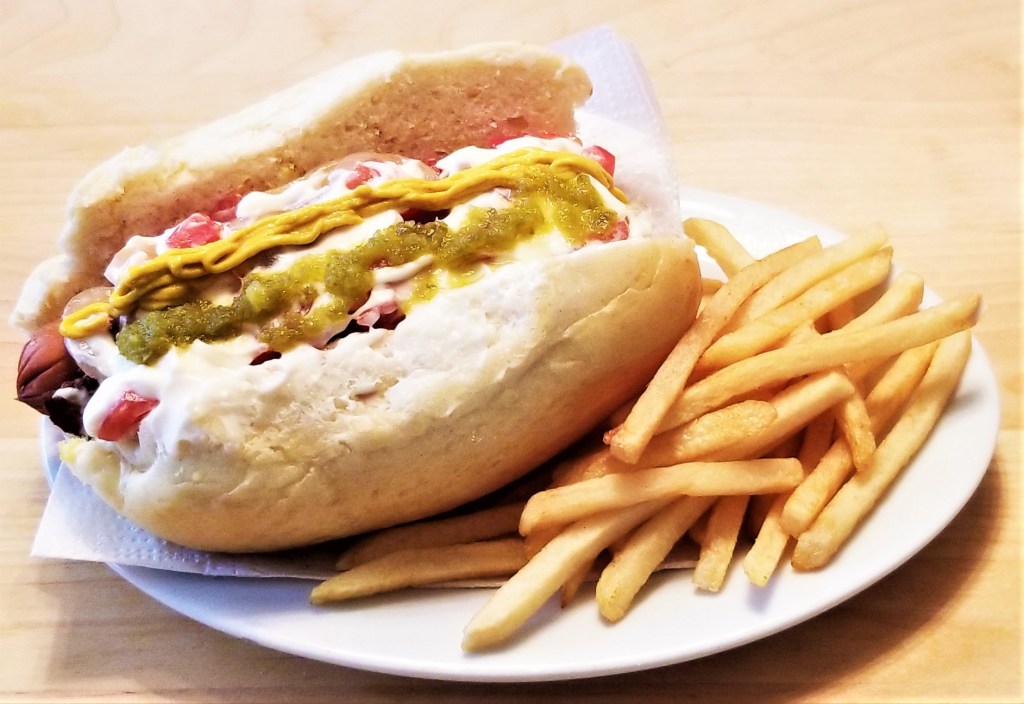
Ciudad Obregón
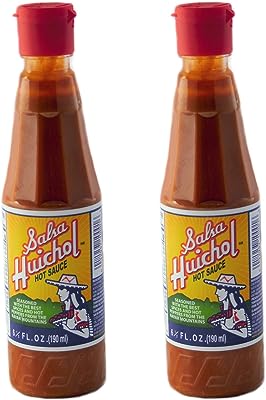
To the classic dogo, add a good helping of bottled Huichol™ sauce:
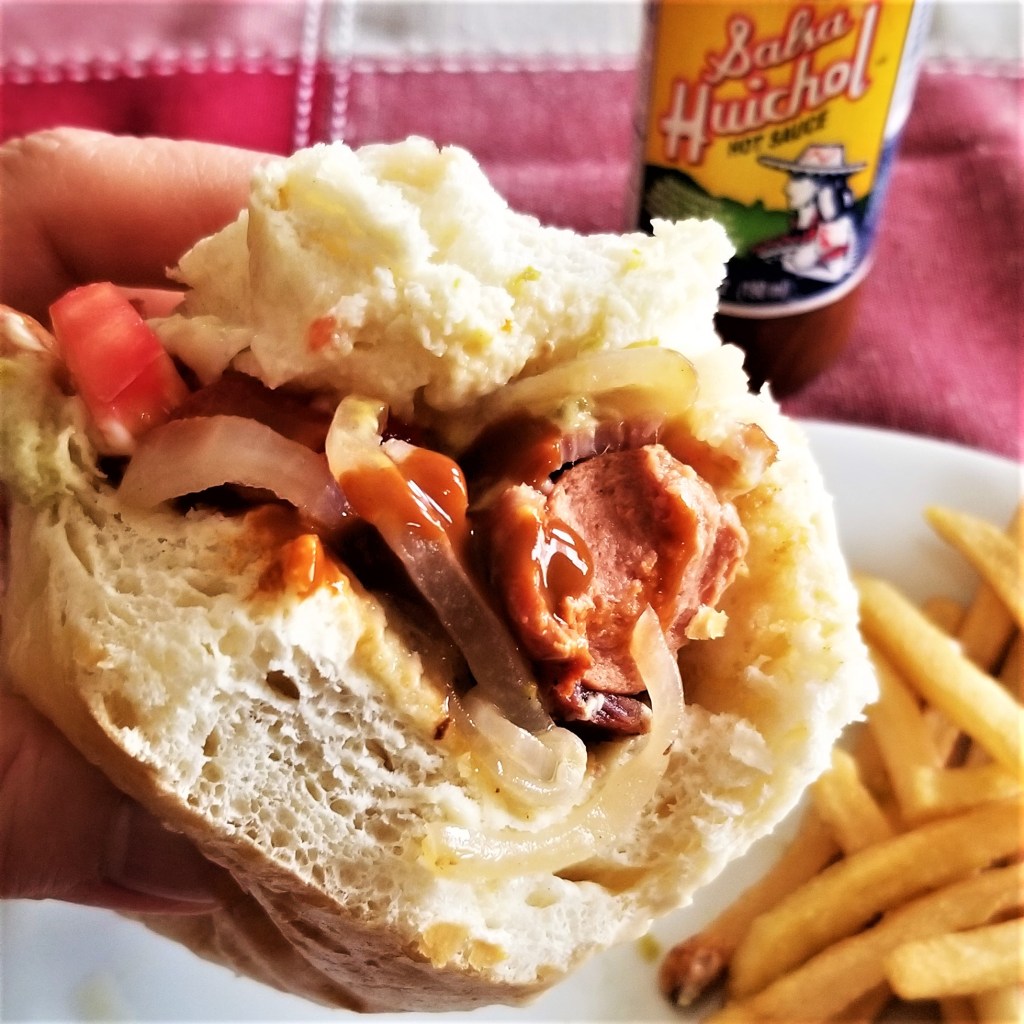
Hermosillo
In Hermosillo, they add beans (probably as a nod to the chili hotdog), and shredded lettuce to the classic:
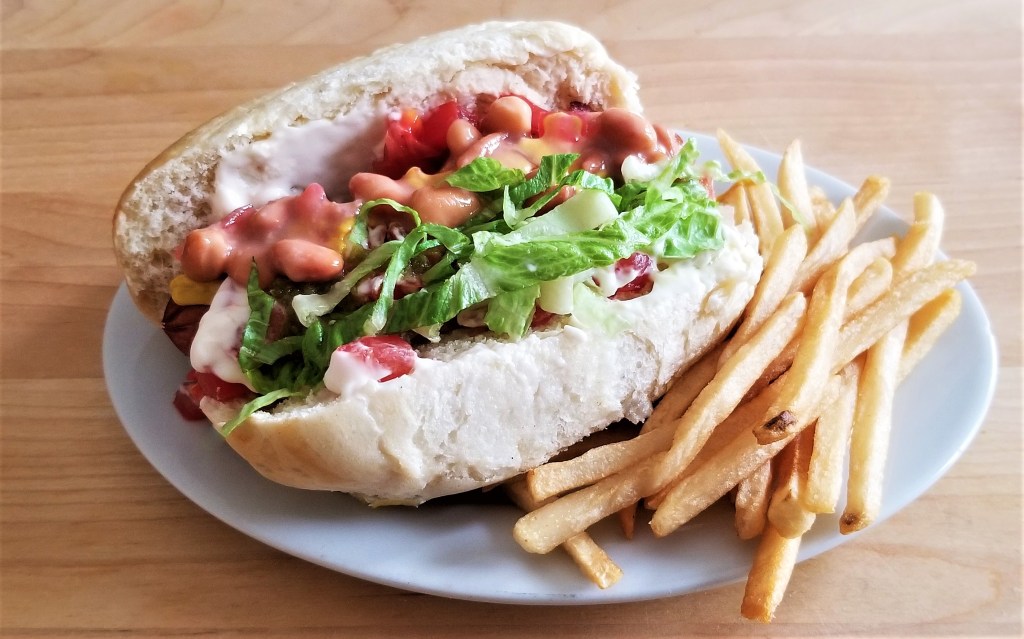
Guaymas
In Guaymas, the buns are smaller, regular size hotdog buns, and chopped raw onions are added to the classic toppings:
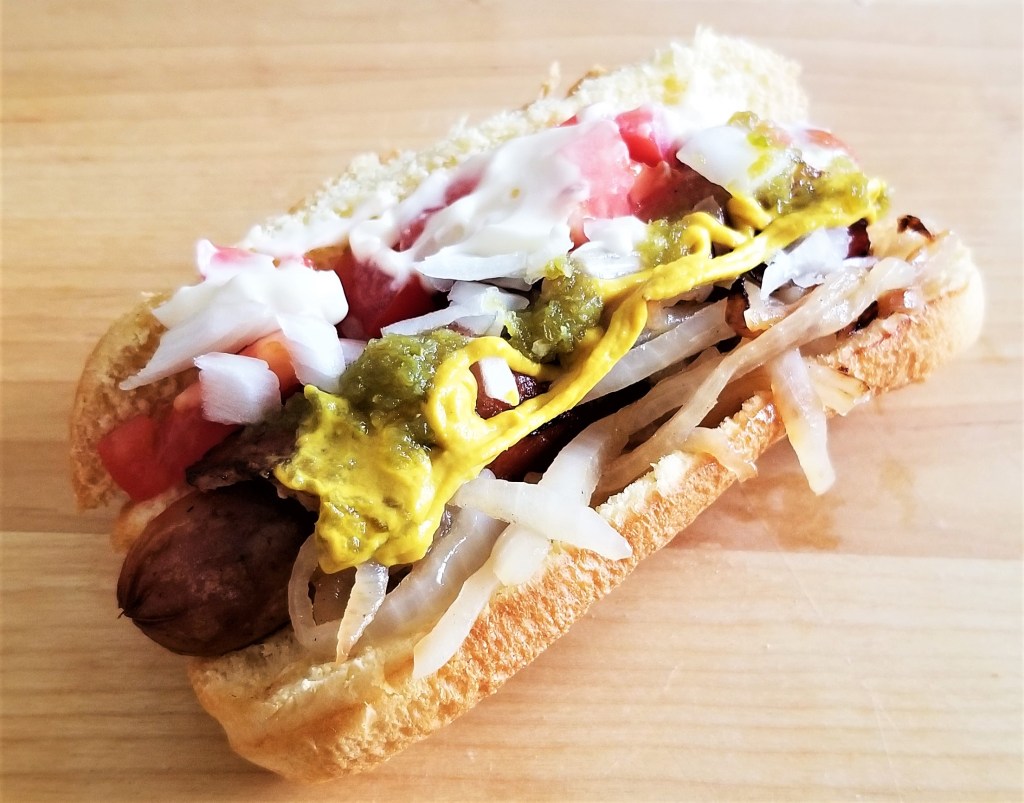
Nogales
Nogales style dogos are similar to Guaymas style, but they add an extra sausage to the mix:
Nowadays, many dogo restaurants and stands have a whole topping bar, and people may add as much as they want; toppings range from the ones listed already, to stir-fried veggies, such as mushrooms, or peppers, to coleslaw, potato salad, extra bacon, and so on.
Which dogo is your favourite? I liked the classic with mustard and jalapeño sauce the most, especially because of the homemade buns. Stay tuned for the recipe in my next post.
For your convenience, click on the highlighted text below for products available on Amazon™. DISCLAIMER: Any reviews included in this post are my own, for items I have purchased, not provided by any company; as an Amazon Associates Program affiliate, I might receive a commission for any purchases originated from the links below, at no extra cost to you. Thank you to readers who have bought other products starting with a click from my links!
I am bringing my recipe to Full Plate Thursday #653 with Miz Helen @ Miz Helen’s Country Cottage.
I am also sharing my post at Thursday Favourite Things #621, with Bev @ Eclectic Red Barn, Pam @ An Artful Mom, Katherine @ Katherine’s Corner, Amber @ Follow the Yellow Brick Home, and Linda @ Crafts a la Mode.
I am joining Fiesta Friday #497 with Angie @ Fiesta Friday.
I am sharing my recipe at What’s for Dinner? Sunday Link-Up #432 with Helen @ The Lazy Gastronome.






I like the ones from Hermosillo with beans! I didn’t realise there were so many Mexican varieties of hot dogs!
LikeLiked by 1 person
Awesome! And those are just in the one state (Sonora)
LikeLike
I would definitely want to try your dogos even though I stopped eating sausages except for chorizo. I enjoy those chorizo with chickpeas and potato.
LikeLiked by 1 person